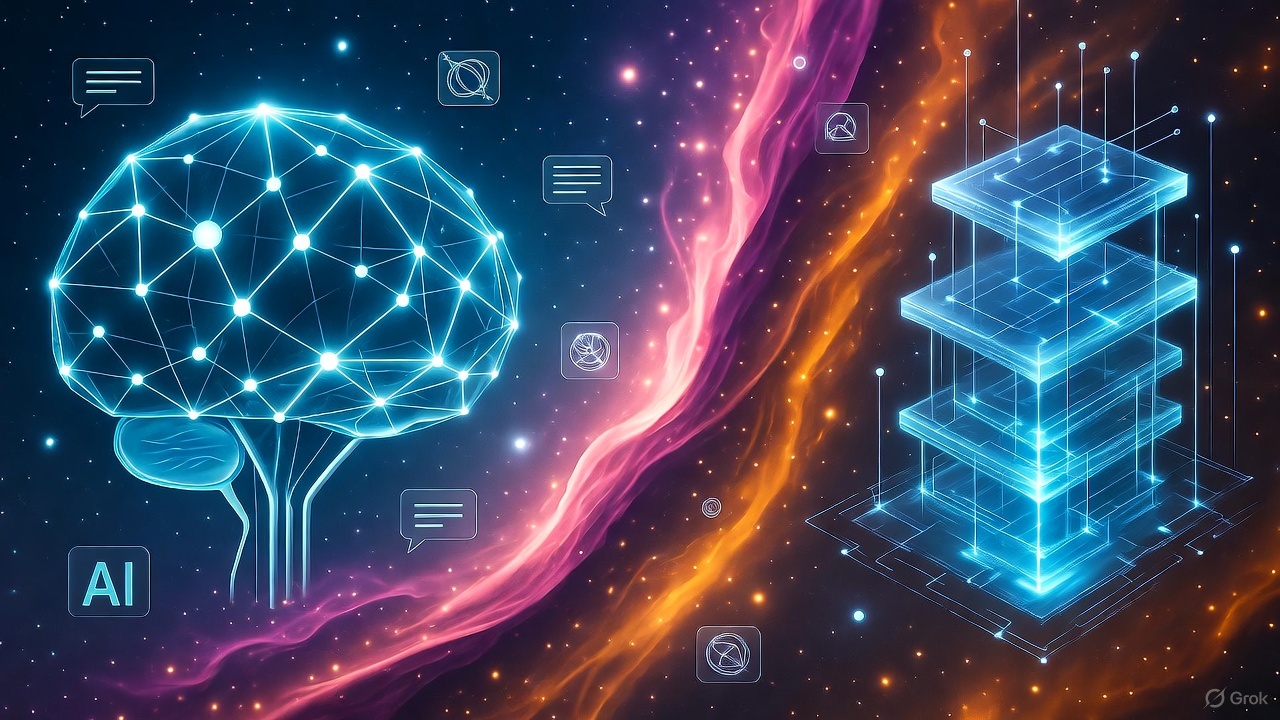
2025 feels like the tipping point where sci-fi meets everyday reality. Remember when AI was just a buzzword tossed around in boardrooms?
Today, it’s the engine behind everything from your personalized Netflix recommendations to the hyper-realistic videos going viral on social media.
But with so many models vying for attention—Transformers churning out eloquent prose, Diffusion models dreaming up stunning visuals—it’s easy to feel overwhelmed.
That’s where this guide comes in. We’re diving deep into the AI models shaping 2025, starting with the stalwarts like Transformers and evolving into the generative wizards known as Diffusion models.
Whether you’re a developer tinkering in your garage, a marketer eyeing the next big campaign tool, or just a curious soul wondering how AI got so darn clever, this 1000+ word breakdown will arm you with the knowledge to navigate it all.
We’ll cover architectures, real-world applications, comparisons, and even a peek at what’s next. Buckle up—AI’s future is brighter (and more chaotic) than ever.
What Are AI Models, Anyway?
A Quick Primer for 2025Let’s start at the basics, because even in 2025, not everyone speaks fluent “neural network.” An AI model is essentially a mathematical blueprint trained on massive datasets to mimic human-like tasks.
Think of it as a super-smart recipe book: feed it ingredients (data), and it whips up predictions, creations, or decisions.
At their core, these models learn patterns through layers of algorithms, adjusting weights via backpropagation to minimize errors. But here’s the 2025 twist—efficiency is king.
With energy costs skyrocketing and regulations tightening around data privacy (shoutout to the EU’s latest AI Act updates), models aren’t just powerful; they’re sustainable and scalable.
Why does this matter? Because the right model can turn a simple chatbot into a creative powerhouse or a basic image editor into a Hollywood effects studio.
If you’re new to this, check out our Machine Learning Basics article for a gentler ramp-up. Now, let’s trace the family tree.
The Evolution of AI Models: From RNNs to the 2025 Powerhouses
AI didn’t wake up one day as a Transformer-wielding giant. It evolved, messy and iterative, from the clunky rule-based systems of the 1950s to today’s probabilistic marvels.
Early days? Recurrent Neural Networks (RNNs) and Long Short-Term Memory (LSTM) units handled sequences like speech recognition, but they choked on long contexts—vanishing gradients, anyone? Enter 2017’s game-changer: the Transformer architecture from Vaswani et al.’s seminal paper on Attention Is All You Need.
This outbound gem shifted focus to self-attention mechanisms, allowing models to weigh word importance dynamically. Boom—GPT series was born.
By 2025, we’ve layered on hybrids. Diffusion models, first popularized in 2020 with Denoising Diffusion Probabilistic Models (DDPMs), flipped the script on generation. Instead of predicting the next token (à la Transformers), they start with noise and iteratively denoise to craft outputs.
This evolution isn’t linear; it’s explosive. Models like Stable Diffusion 3.0 and OpenAI’s Sora are now household names, blending with Transformers in “Diffusion Transformers” (DiTs) for video gen that rivals Pixar.The result?
A landscape where AI isn’t just smart—it’s creative. For a deeper dive into ethical pitfalls along this path, read our AI Ethics in 2025 piece.
Transformers: The Unstoppable Force Behind Language and Beyond
If Transformers were a band, they’d be the Rolling Stones—timeless, versatile, and still packing stadiums in 2025.
At heart, they’re encoder-decoder stacks using multi-head attention to process sequences in parallel, ditching RNNs’ sequential bottlenecks.
Why the hype? Scalability. Train on terabytes of text, and you get beasts like OpenAI’s GPT-4o mini or Anthropic’s Claude 3.5, which now handle multimodal inputs (text + images) with finesse. In 2025, Transformers dominate large language models (LLMs), powering everything from code autocompletion in GitHub Copilot to real-time translation earbuds.
But they’re not flawless. Hallucinations—those confident-but-wrong outputs—persist, though techniques like Retrieval-Augmented Generation (RAG) mitigate them by pulling in external facts. Energy hogs?
Yeah, training a single Transformer can guzzle as much power as a small town, but optimizations like sparse attention and quantization are trimming the fat.
Real-world wins: Legal firms use Transformer-based models for contract review, saving hours. Marketers? They’re scripting ad copy that converts 20% better.
Want tools to experiment? Our roundup of the Best AI Tools for 2025 has you covered. To visualize this, here’s a quick table comparing classic vs. modern Transformers:
| Aspect | Classic (2017) Transformers | 2025 Evolutions (e.g., GPT-4o) |
| Attention | Multi-head, full sequence | Sparse + hierarchical for efficiency |
| Parameters | ~100M | 1T+ with distillation |
| Applications | NLP basics | Multimodal (text, vision, audio) |
| Challenges | Compute-intensive | Bias reduction via fine-tuning |
Transformers aren’t going anywhere—they’re the backbone. But for pure creativity, enter Diffusion.
Diffusion Models: Crafting Reality from Noise in 2025
Picture this: You throw digital sand into the wind (pure noise), then sculpt it step by step into a masterpiece. That’s Diffusion models in a nutshell—a probabilistic process that learns to reverse entropy, turning chaos into coherent outputs.
Rooted in non-equilibrium thermodynamics (yeah, physics envy), Diffusion starts by noising data forward, then trains a neural net (often a U-Net) to predict and subtract noise backward.
The magic? Iterative refinement yields photorealistic results without the mode collapse plaguing GANs (Generative Adversarial Networks).2025’s Diffusion scene is electric.
Stable Diffusion XL Turbo generates 1024×1024 images in seconds on consumer GPUs. Video? OpenAI’s Sora and Runway’s Gen-3 Alpha create minute-long clips from text prompts, indistinguishable from stock footage.
Audio? Suno and Udio compose full songs. Even language is getting diffus-ed—Google’s Gemini Diffusion matches autoregressive LLMs in fluency while being more controllable.
Strengths: Parallel sampling for speed, inherent diversity in outputs. Weaknesses? Slower inference than one-shot Transformers, though DiTs (Diffusion Transformers) fuse the best of both, using Vision Transformers instead of U-Nets for latent-space wizardry.
As one expert put it in a recent Hugging Face blog, “Diffusion isn’t replacing Transformers—it’s remixing them.
“Applications explode: Architects visualize designs pre-build; therapists use custom visuals for exposure therapy. For inspiration on creative uses, see our Generative AI Applications.
Transformers vs. Diffusion: Head-to-Head in the 2025 Arena
So, which reigns supreme? It depends on the quest. Transformers excel at sequential reasoning—your go-to for chatbots, summarizers, or code gen.
They’re “one-pass” pros: input a prompt, get a coherent stream.
Diffusion? Masters of unstructured creation. They iterate (20-100 steps) to build from scratch, shining in images, videos, and now text via diffusion-LLMs. But that iteration costs compute—though 2025 hardware like NVIDIA’s Blackwell GPUs slashes it.Pros/Cons showdown:
- Speed: Transformers win (sub-second responses). Diffusion catching up with distilled variants.
- Creativity: Diffusion edges out for visuals; Transformers for narrative depth.
- Scalability: Both huge, but Transformers train easier on text corpora.
- Hybrid Future: DiTs like those in Liquid AI’s research blend them, generating 4K videos at 30fps.
In benchmarks (e.g., LAION’s 2025 eval), Diffusion tops FID scores for image fidelity, while Transformers rule GLUE for language. Bottom line: Use Transformers for understanding, Diffusion for invention. For predictions on hybrids, peek at our Future of AI Predictions.
Emerging AI Models Stealing the Spotlight in 2025
Transformers and Diffusion are the headliners, but 2025’s undercard is stacked. Enter:
- State Space Models (SSMs): Mamba’s efficient alternative to Transformers for long sequences, devouring 1M-token contexts without bloating.
- Mixture of Experts (MoE): Grok-2 and Mixtral route queries to specialist sub-models, slashing inference costs by 80%.
- Hybrid Gen Models: Flux.1 (Black Forest Labs) merges Diffusion with rectifiers for sharper text-in-images.
Top 8 contenders per recent CometAPI analysis: GPT-5 whispers, Luma Dream Machine for 3D, Claude Opus, Gemini 2.0, Runway ML, Flux, Midjourney V7, Suno V4. These aren’t silos—they interoperate via APIs on platforms like Hugging Face.
Future Trends: Where AI Models Are Headed Next
Gazing into 2025’s crystal ball? Expect neuro-symbolic hybrids fusing statistical learning with rule-based logic for fewer errors.
Edge AI will push models onto devices—think iPhone-grade Diffusion for on-device photo editing.
Sustainability mandates: Carbon-aware training, where models pause during peak grid hours. And ethics? Baked-in fairness checks to curb biases.
By 2030, diffusion-based LLMs could generate entire novels iteratively, per Apolo.us forecasts.
Challenges loom: IP lawsuits over training data, geopolitical chip wars. But opportunities? Infinite. AI models will democratize creation, from indie game devs to global problem-solvers.
How to Get Started with AI Models in 2025: Hands-On Tips
Theory’s great, but action seals it. Start free: Hugging Face’s Transformers library for Python tinkering—pip install transformers and you’re prompting GPT-J in minutes.
For Diffusion, grab Diffusers lib and run Stable Diffusion locally via Automatic1111’s web UI. Experiment: Fine-tune on your sketches for custom art.
Resources? Dive into this explanatory YouTube video: LLMs, Diffusion Models & Transformers Explained Simply by AI Explained—20 minutes of clarity amid the jargon.Pro tip: Join communities like Reddit’s r/MachineLearning. Track papers on arXiv for bleeding-edge drops.